
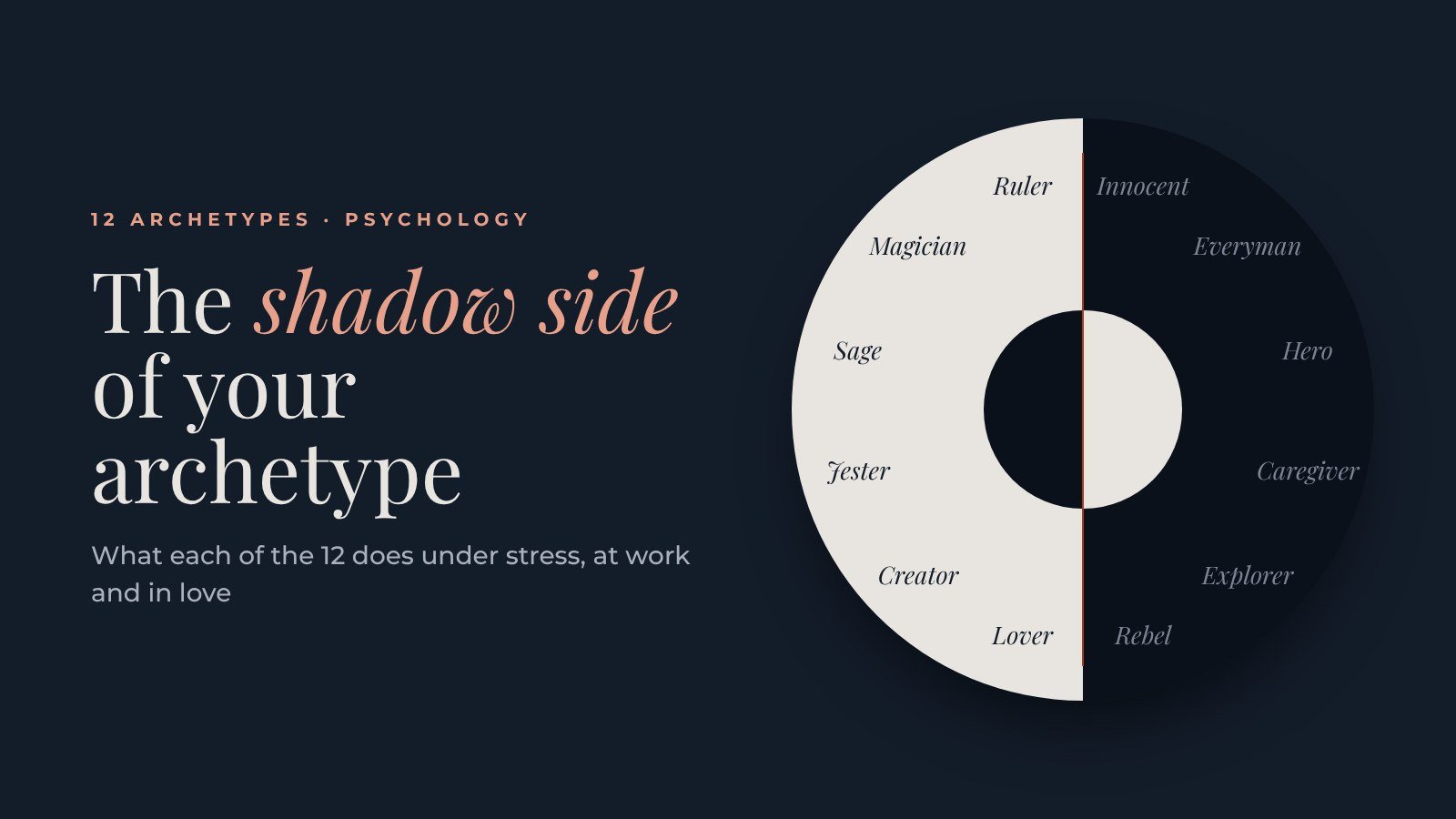
When people take my archetype test, they usually read the description of their top archetype and smile. Yes, that’s me. Warm, wise, brave, creative.
And then something stressful happens. A deadline, a difficult conversation, a partner who doesn’t answer for six hours. Suddenly the wise Sage is rereading the same email for the fortieth time, and the warm Caregiver is quietly furious with everyone she has helped this week.
That is your archetype’s shadow. Each of the 12 archetypes has one, and it shows up exactly when you have the least energy to notice it.
In this post I’ll go through all 12: what each shadow looks like at work and in relationships, and one small thing you can try instead. If you haven’t taken the test yet, take it first. This post reads very differently once you know your top 3.
What a shadow is, in two minutes
Jung called the shadow the part of us we would rather not see. It holds the traits we learned were unacceptable, and it doesn’t disappear when we ignore it. It just starts acting on our behalf.
I like to think of the shadow as your strength with the brakes off. The Caregiver’s kindness becomes self-erasing. The Ruler’s sense of responsibility becomes control. The quality is the same; the dose and the motive change.
Stress brings it out for a simple reason. When you feel safe, you choose how to act. When you feel threatened, the oldest strategy in your repertoire takes the wheel, usually the one that helped you survive as a child. That strategy once made sense. Today it mostly costs you sleep, money and relationships.
So as you read, look for your top 3, not just your first archetype. Most of us recognise one shadow straight away and get a little defensive about a second one. The second one is usually the more interesting.
At a glance
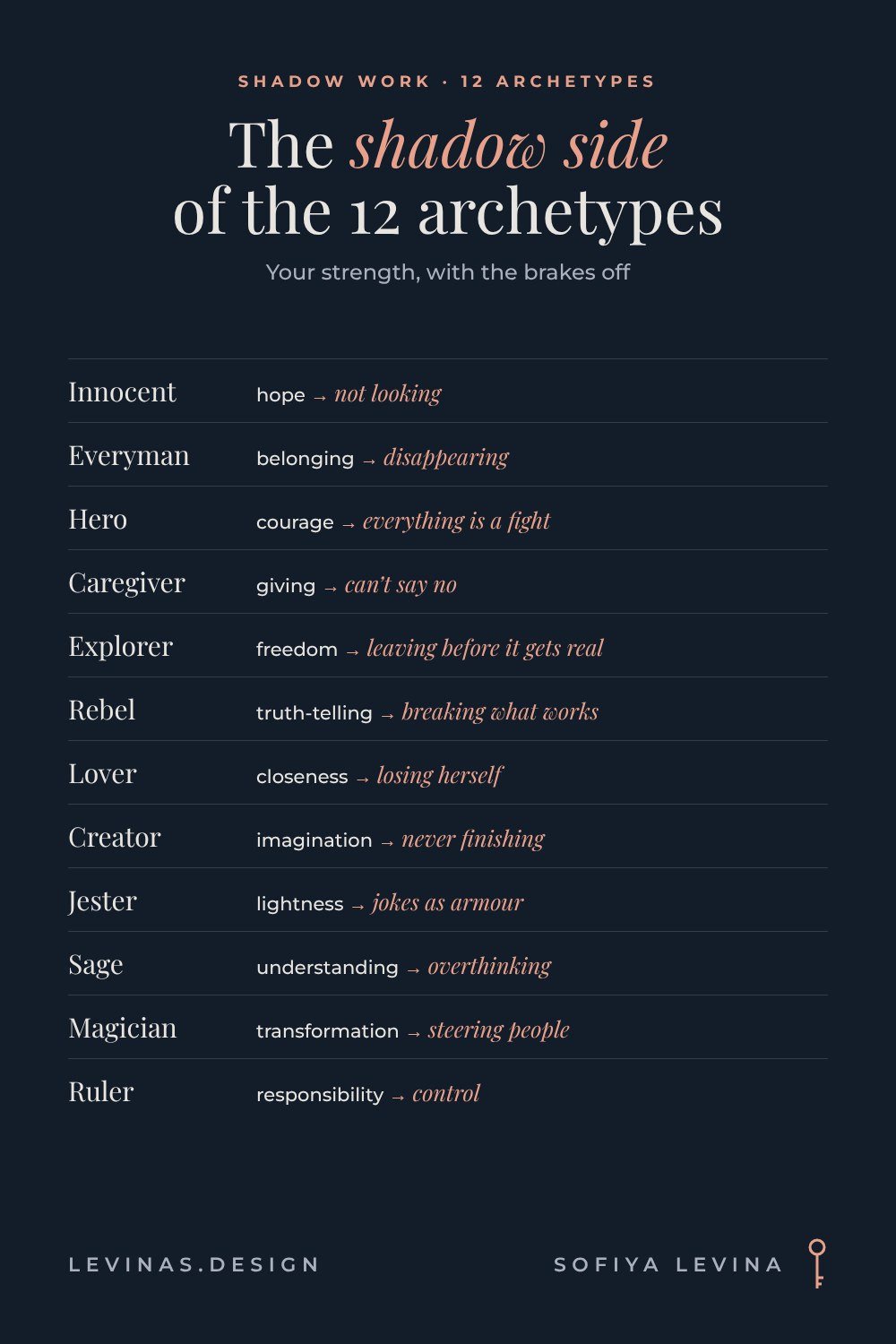
Your strength, with the brakes off
Innocenthope → not lookingEverymanbelonging → disappearingHerocourage → everything is a fightCaregivergiving → can’t say noExplorerfreedom → leaving before it gets realRebeltruth-telling → breaking what worksLovercloseness → losing herselfCreatorimagination → never finishingJesterlightness → jokes as armourSageunderstanding → overthinkingMagiciantransformation → steering peopleRulerresponsibility → controlThe 12 archetypes under stress
hope → not looking
The Innocent: pretending everything is fine
The Innocent's gift is hope. Under stress, hope turns into not looking. The bank statement stays unopened, the strange tone in his message gets a smiley in reply, and the inner voice says: if I don't make a fuss, it will sort itself out.
- At work
- Agrees to unrealistic deadlines, then feels betrayed when they collapse.
- In love
- Stays years too long, because leaving would mean admitting something went wrong.
belonging → disappearing
The Everyman: disappearing into the group
The Everyman wants to belong. Under stress she becomes invisible on purpose: no opinion in the meeting, “whatever you prefer” at dinner, and a quiet resentment that nobody ever asks what she wants.
- At work
- Does solid work and lets others present it.
- In love
- Adapts so well that after a few years she can’t say what she even likes.
courage → everything is a fight
The Hero: turning life into a battlefield
The Hero’s strength is courage. Under stress everything becomes a fight to win, including rest. A weekend off is a test of discipline, and asking for help feels like losing.
- At work
- Takes on the hardest project to prove something, then burns out alone.
- In love
- Competes with the partner instead of leaning on them.
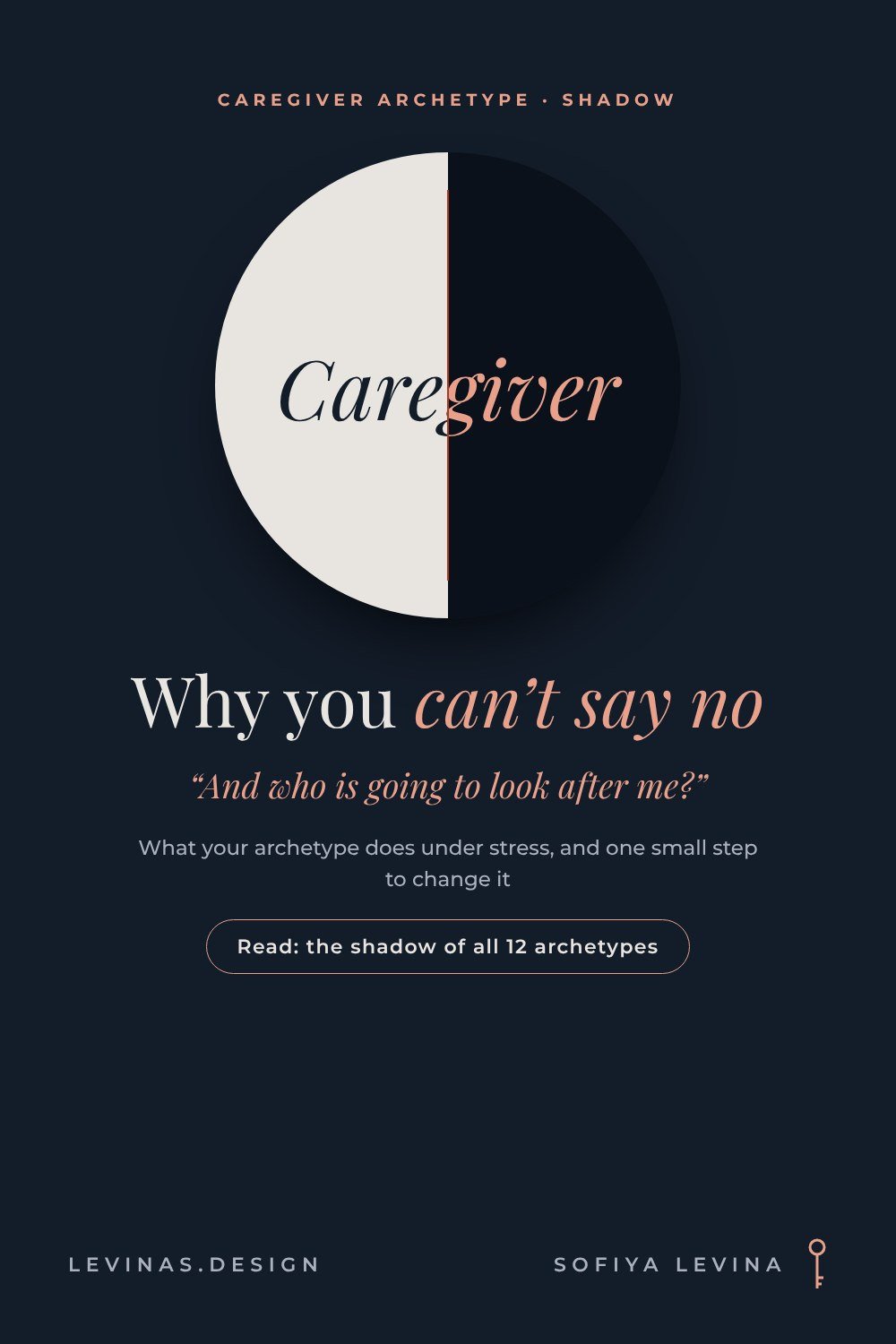
giving → can’t say no
The Caregiver: the helper who can’t say no
The Caregiver gives. Under stress she gives more, because being needed is the only safe place she knows. Then one evening she washes the last plate and thinks: and who is going to look after me?
- At work
- Becomes everyone’s emotional support and nobody’s priority.
- In love
- Chooses partners who need saving, and calls the exhaustion love.
freedom → leaving before it gets real
The Explorer: leaving before it gets real
The Explorer needs freedom. Under stress, freedom becomes escape: a new city, a new job, a new course, anything that saves her from the moment where things get close and ordinary.
- At work
- Starts strong, gets bored at month four, and calls it “outgrowing” the role.
- In love
- Feels trapped exactly when the other person starts to feel safe.
truth-telling → breaking what works
The Rebel: breaking things that work
The Rebel sees what’s wrong and says it. Under stress she fights the system so hard that she forgets what she wanted from it. Every rule feels like a personal insult.
- At work
- Wins the argument with the boss and loses the project.
- In love
- Tests the partner with provocations to see if they’ll leave.
closeness → losing herself
The Lover: losing herself in someone else
The Lover’s gift is closeness. Under stress she merges: his mood becomes her weather, and an unanswered message turns into a full investigation with her girlfriends as the analytics department.
- At work
- Takes feedback as rejection of her as a person.
- In love
- Gives up friends, hobbies and opinions to stay close.
imagination → never finishing
The Creator: perfecting instead of finishing
The Creator makes new things. Under stress she keeps making them, and never finishes any. The idea in her head is perfect; the real version could disappoint, so it stays at 90%.
- At work
- Redesigns the presentation the night before and misses the actual point.
- In love
- Falls for the potential of a person, then feels let down by the real one.
lightness → jokes as armour
The Jester: joking so nobody gets close
The Jester lightens everything. Under stress the humour becomes armour. Everyone laughs at her story about the terrible week, and nobody notices that she has said nothing true.
- At work
- The favourite colleague nobody takes seriously when it matters.
- In love
- Turns every serious conversation into a joke, then feels alone.
understanding → overthinking
The Sage: thinking instead of living
The Sage wants to understand. Under stress she researches. Twelve tabs, three books and a podcast about the decision, and the decision itself still waiting. I just need a bit more information.
- At work
- Brilliant analysis, late action.
- In love
- Explains her feelings beautifully instead of having them.
transformation → steering people
The Magician: controlling the outcome from behind the curtain
The Magician transforms. Under stress she starts to manage people instead of situations: a bit of charm here, a strategic silence there, and everyone ends up exactly where she wanted, except that nobody fully trusts her.
- At work
- The person who “just knows how to handle” the boss, and is exhausted by it.
- In love
- Reads the partner so well that she stops asking and starts steering.
responsibility → control
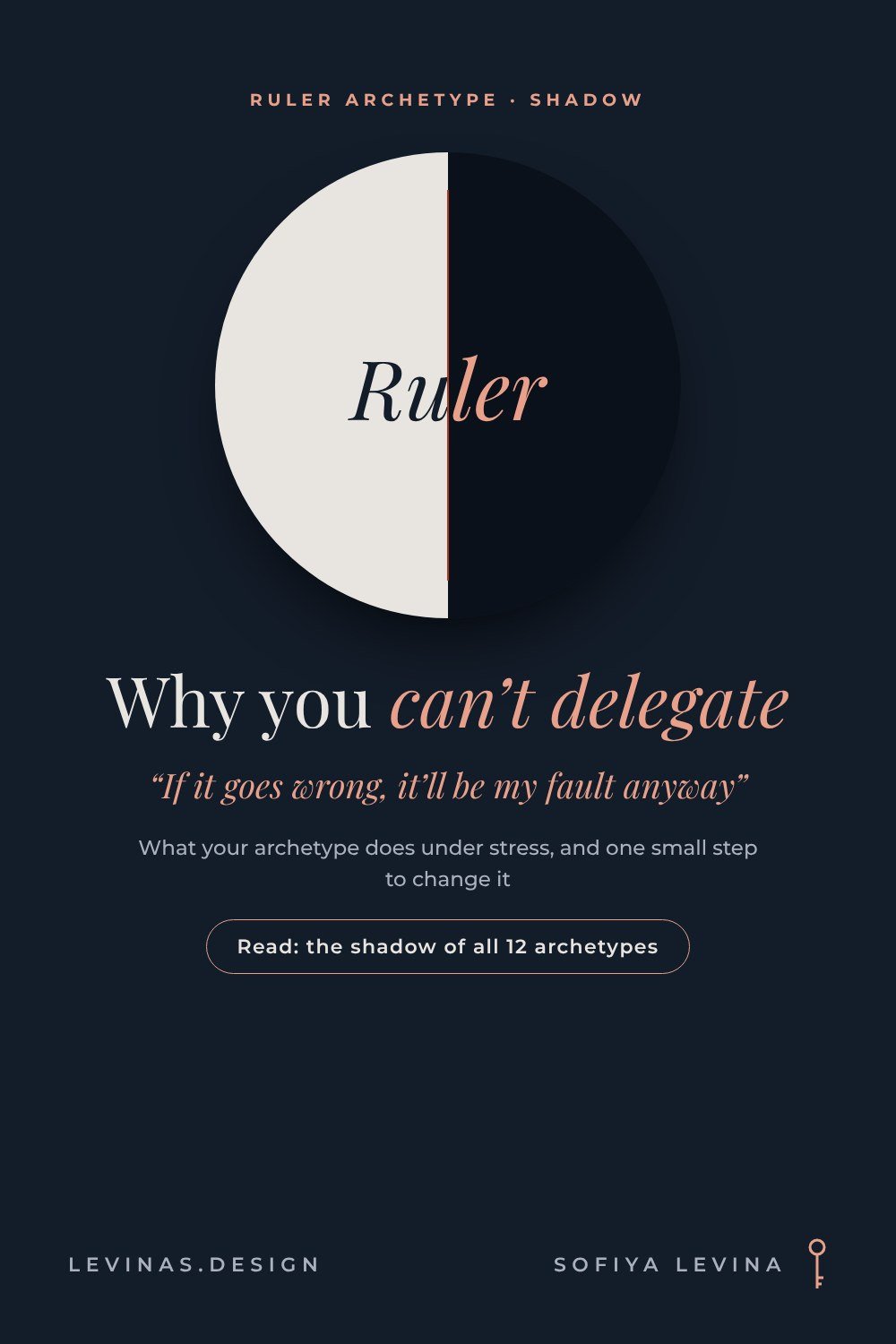
The Ruler: holding everything so it doesn’t fall
The Ruler takes responsibility. Under stress she takes all of it. Delegating feels dangerous, because if something goes wrong it will be her fault anyway, so she might as well do it herself. At 11 p.m.
- At work
- The bottleneck of her own team, proud and furious at the same time.
- In love
- Organises the relationship like a project and wonders why it feels lonely.
A small experiment for this week
Pick the shadow that made you a little uncomfortable while reading. Not the one you agreed with straight away, the one you wanted to argue with.
For seven days, just notice when it switches on. You don’t need to change anything yet. Write down three things each time:
By day four most people see a pattern. The same type of situation, the same feeling, the same move. And usually a thought appears: I’ve been doing this since I was a child.
That thought is where the real work begins. Noticing a pattern feels like a breakthrough, and then on Monday morning the old strategy wins again. That is completely expected. A strategy that protected you for twenty years won’t step aside because you read about it in a blog post. It needs to understand that the danger it was protecting you from is over, and that takes a different kind of conversation.
If you’d like to see how patterns repeat across years and relationships, read why we keep ending up in the same situations.
If you recognised yourself
This is exactly what I work on with my clients. We look at the pattern your shadow repeats: where it came from, what it still protects you from, and what you could do instead, at work, in relationships and with money.
I’m a psychoanalytic coach, which means we don’t stop at tips and habits. We find the reason the habit exists, and that is usually what lets it go.
Book a session with me →Not sure yet which archetypes lead you? Take the free archetype test first.