
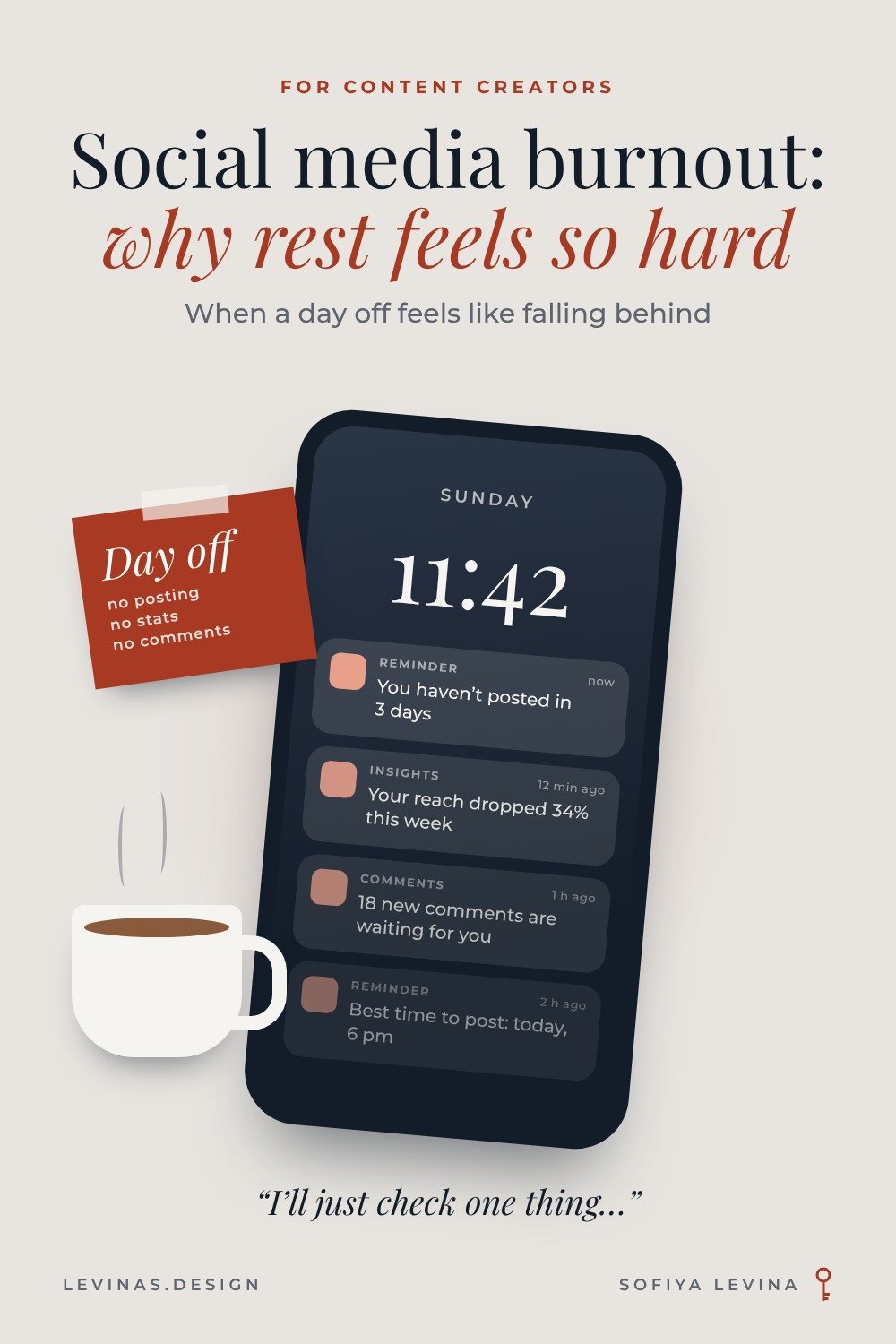
Content creator burnout rarely comes from one bad week. It builds up when one person does the work of five: you film on Monday, edit until one in the morning on Tuesday, reply to DMs on the bus, chase a brand for an unpaid invoice and make three versions of a thumbnail on Sunday night.
You know you should outsource some of it. You may even have saved a few editors’ portfolios. And still, months later, it’s all on you, and you’re more tired every month.
What content creator burnout actually looks like
Burnout is more than being tired. The World Health Organization describes it through three signs: exhaustion, growing mental distance from your work, and a feeling that you’re no longer effective. In a creator’s life they tend to look like this.
Burnout signs
What it looks like in a creator’s life
Many creators keep going for months with all three, because from the outside nothing has changed. The videos still come out on schedule.
Why creators rarely talk about it
In July 2026, Cornell researchers Rosie Nguyen and Brooke Erin Duffy published a study on creator burnout based on 78 interviews with creators. They found that burnout often goes unsaid. Content creation is seen as a dream job, creators feel grateful to the audience they built, and complaining in public can bring backlash. They also noticed that male creators were more likely to try to “grind” their way through it.
One creator in the Creators 4 Mental Health report described it like this: “You’re surrounded by comments, but no one actually sees you.” That loneliness makes burnout worse, and it also makes it harder to ask for help, including practical help with the work.
“I’ll hire someone later”
The reasons creators give usually sound practical: there’s no budget yet, or it would take longer to explain than to do. Sometimes that’s true. In a 2025 survey of more than 500 creators by Creators 4 Mental Health, 62% said they experience burnout, and 69% said their work leaves them financially insecure. Another survey of 1,000 creators by Billion Dollar Boy found that 52% had burned out because of their career, and 37% had thought about leaving it. When income goes up and down, paying someone every month feels risky.
Shira Lazar, who founded Creators 4 Mental Health, put it simply: creators are “doing the work of entire teams”. A team would never let one person film, edit, run the inbox and manage the money for long.
But I often meet creators who can afford help and still don’t take it. The psychologists Robert Kegan and Lisa Lahey describe this as a hidden commitment. Part of you wants to grow, and another part is quietly committed to something else, like staying in control or being the one who does it all. Every time you take a task back, you protect that second commitment.
So instead of asking whether you can afford it, ask yourself what you’re protecting by doing everything yourself.
What to outsource first
Before we get to the psychology, here’s a simple way to sort your tasks. Ask two questions about each one: does it repeat often, and how bad is it if it goes wrong?
Delegate first
Low risk · repeats oftenSubtitles and captions, scheduling and cross-posting, cutting short clips from long videos, sorting your inbox
Delegate with a check-in
High risk · repeats oftenEditing your main videos, first replies to brand emails, moderating comments
Delegate next
Low risk · one-offDesigning your media kit, setting up a website, research for a new series
Keep, for now
High risk · one-offYour ideas and what you say on camera, choosing brand partners, responding to a public conflict
Most creators can find two or three tasks in the first box straight away. If you look at that box and still feel resistance, keep reading.
Six reasons creators hold on
The hidden commitment usually depends on your leading archetype. Here’s how it tends to sound.
By archetype
What each one is protecting
Most people lead with two or three archetypes, so the reasons stack. A Ruler with a strong Lover side wants control over every post and also personally answers every comment. No wonder there’s no time left to film.
“If someone else touches it, is it still me?”
For creators there’s one more layer. Your content is made of your face, your voice and your life. When a business owner hands over the invoices, nobody thinks the company has changed. When a creator hands over the editing, it can feel like handing over a piece of yourself.
This fear is worth taking seriously. Behind it there’s often an old belief that you’re loved for what you produce, and that if you stop producing it with your own hands, people will notice and leave. That belief usually started long before your first post.
How to start letting go
Pick one task from the “delegate first” box, something where a mistake would be annoying but not harmful. Hand it over properly once: explain the result you want, show one example, agree on a deadline and a single check-in.
Then comes the hard part. If the result is about 80% of what you’d do, leave it. Notice how strong the urge to fix it is, and what you’re afraid will happen if you don’t. A week later, compare what actually happened with what you were afraid of. Then take the next task.
Founders and managers go through exactly the same thing. If you lead a team as well as an account, you may also like why leaders can’t delegate.
Outsourcing helps, and rest still matters
Handing over tasks gives you back hours. It doesn’t automatically give you rest. Many creators fill the freed time with more content, because they’re afraid the algorithm will punish them for slowing down.
Try one more experiment: choose one day a week with no posting, no stats and no comments. Notice what happens inside you on that day. If what comes up is guilt or anxiety, that’s useful information. It tells you how much of your worth you’ve placed in being constantly productive.
When burnout keeps coming back
If you’ve tried to outsource and keep taking everything back, or if you rest for a week and come back just as tired, the pattern probably runs deeper than time management. That’s exactly the kind of thing I work with.
I work with influencers, creators and professionals who are building an online presence. You can read how on the coaching for creators page, or start by finding out your leading archetypes with the free archetype test.
And if exhaustion comes together with hopelessness or thoughts of harming yourself, please talk to a doctor or contact a crisis line. You can find free helplines for your country at findahelpline.com.
Burnt out from doing everything yourself?
Start with a free 15-minute call. Tell me what you can’t let go of, and we’ll see what would help: one deep 90-minute session or a 3-month program.
Book a free 15-min call →Or read more about coaching for creators.
Sources: Nguyen, R. & Duffy, B. E. (2026). “Creator Burnout is Real”: Risk, Responsibility, and Un/speakability in Platform-Dependent Creative Labor. New Media & Society. · Creators 4 Mental Health & Lupiani Insights (2025), survey of 500+ creators. · Billion Dollar Boy & Censuswide, survey of 1,000 creators. · World Health Organization, burnout in ICD-11. · Kegan, R. & Lahey, L. (2009). Immunity to Change.